
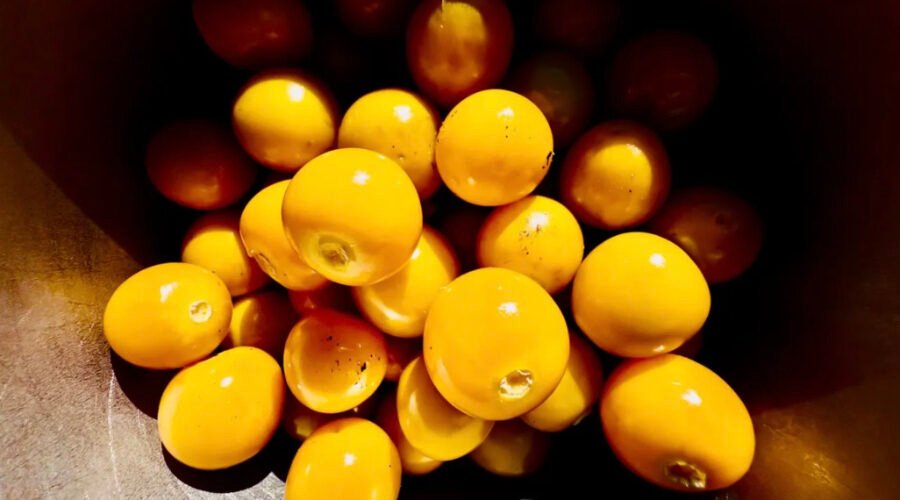
Cape gooseberry
Story by Russ Grayson, May 2026
It is a welcome self-seeding presence in our home garden, cape gooseberry. Every year it returns to provide us with its intensely-flavoured, tart-tasting yellow berries.
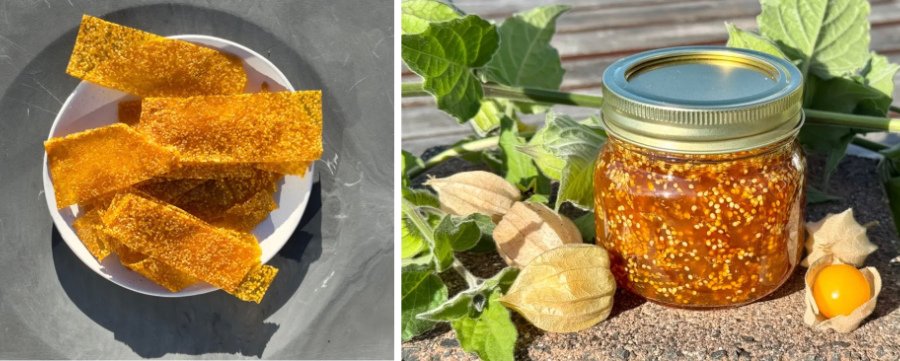
We harvest the berries in late summer and on into autumn, eat them raw or dry them. We also make them into fruit leathers by blending them into a slurry, forming into strips and then drying. Dried, they can also be turned into a powder for adding to recipes.
The bushy plant is one among others forming a shrub layer below our young fruit trees. We live in coastal, cool temperate Tasmania, so our small orchard area is structured as a ground layer of ground cover plants that include perennial and annual vegetables, a shrub layer that includes the cape gooseberry and the canopy of stone and other fruit.
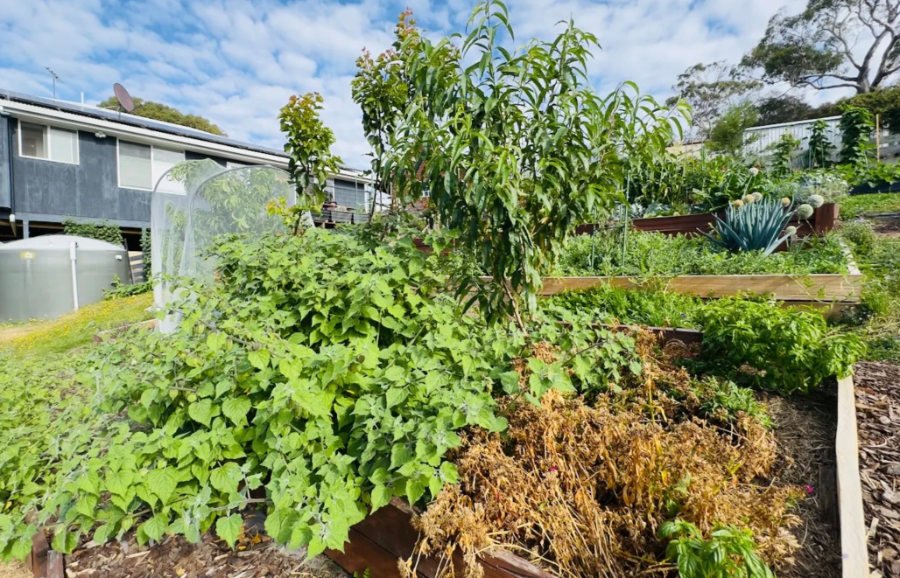
Cape gooseberry
Common names: Cape gooseberry, goldenberry, Peruvian groundcherry; regional names include uchuva, aguaymanto, uvilla
Family: Solanaceae
Genus: Physalis
Species: Physalis peruviana
Centre of diversity
Andes of Chile, Peru, Ecuador and Colombia, especially the mid‑ to high‑elevation zones.
Ecology
Climate
Upland tropics, subtropics and warm temperate regions; optimum mean annual temperature roughly 13–18 °C; tolerates light frosts but not severe freezing.
Native habitat
Forests, forest edges, riparian areas and disturbed sites on slopes.
Elevation
500–3000m in Andes; can grow from sea level to ~2,000m in subtropical and warm‑temperate regions.
Soil and moisture
Prefers well‑drained, moderately fertile soils.
Drought tolerance
Moderate.
Seed dispersal
By animals, water.
Associations
Forms associations with mycorrhizal fungi, participating actively in mycorrhizal networks (Diversity of arbuscular mycorrhizal fungi communities)
C3 photosynthesis (pathway plants use to convert atmospheric CO₂ into organic carbon).
Growth form
- diffusely branched, herbaceous to somewhat woody shrub
- 1.0–1.6 m tall; it grows to around a little over a metre wide here in our cool temparate climate, forming a bushy shrub
- stems are ribbed, hairy, often purplish.
Leaves
Roughly heart-shaped and usually have entire (non-toothed) margins; velvety; nearly opposite, to about 10–15cm long
Flowers
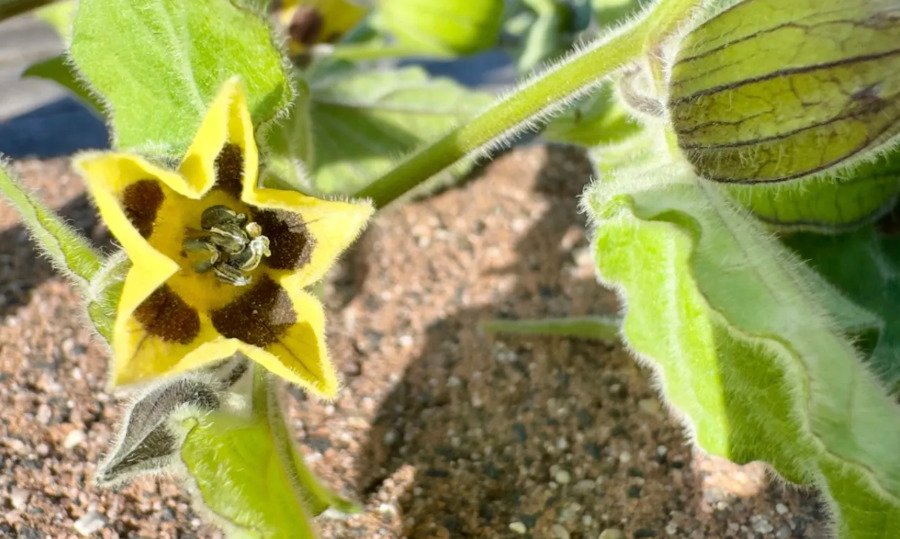
Bell‑shaped, yellow to creamy‑yellow corolla with dark purple‑brown spots in the throat; borne in leaf axils.
Fruit
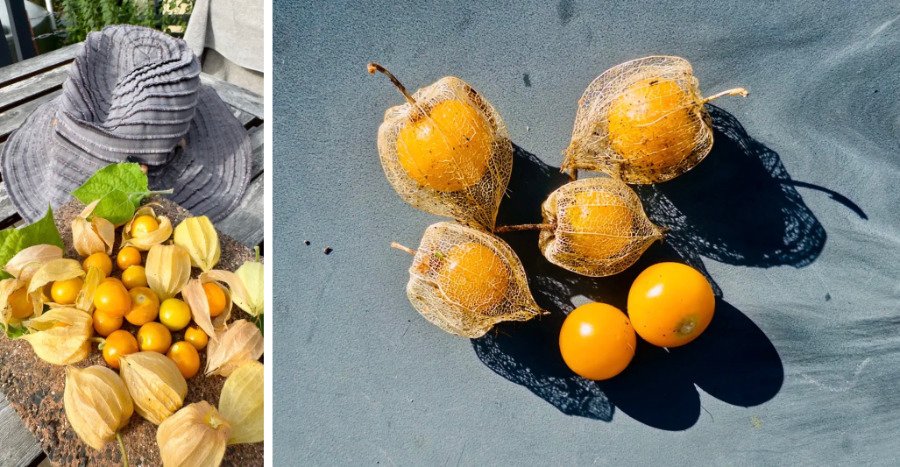
- waxy orange‑yellow berry about 1cm diameter enclosed in an inflated, straw‑coloured papery calyx; ripens 70–80 days after flowering
- the papery husk provides post‑harvest keeping and protection from pests
- fruit development is often strongest under cooler conditions than the initial vegetative growth
- growth and fruiting respond positively to elevated light and moderate temperatures.
Lifespan
Perennial in frost‑free and tropical climates.
An annual or short‑lived perennial in temperate areas where it may die back in winter.
In frost‑free climates it can persist as a perennial shrub, resprouting from the base. In colder situations it behaves as a reseeding annual from dropped fruit.
Reproduction
By seed; plants self‑fertilise readily but also cross‑pollinate via insect activity.
- numerous tiny seeds per berry, dispersed by animals, water and human cultivation
- self‑sowing around gardens and disturbed sites is common; excessive self‑seeding may need management.
Growth timeline
- Seedling establishment in spring after last frosts.
- Vegetative growth in late spring through summer under warm conditions.
- Flowering mainly in late spring to late summer.
- Fruiting is typically mid‑summer through autumn, with main flush in late summer–early autumn; fruit set and quality improve in cooler, drier late‑season conditions.
Management notes for SE Australia including Tasmania:
- grow in full sun
- shelter from strong winds; stake in windy, coastal or exposed sites — branches are brittle when laden with fruit
- water regularly during establishment and flowering; avoid prolonged waterlogging
- mulch to stabilise soil moisture and temperature.
Uses
- food: tart tasting berries for fresh eating and making into jams, chutneys, desserts and drying; fruits are rich in vitamin C, carotenoids and various polyphenols
- plant diversity in garden
- the lantern‑like husks and bright yellow berries make an attractive informal hedge or edible ornamental.
Uses in the permaculture garden
- a Zone 2 species; in Zone 2 orchard/forest garden, cape gooseberry can be used as an understory shrub below the fruit tree canopy
- food
- habitat and plant diversity in the garden/orchard
- fast‑fruiting pioneer shrub to quickly occupy sunny spaces and beds while slower-growing perennials establish
- use in mixed annual–perennial guilds with other Solanaceae and herbs
- branching canopy and persistent husks provide small habitat niches and food for insects and birds.
Folklore
Long‑cultivated in the Andes as a traditional highland fruit where it is known by indigenous and Spanish‑derived names such as uchuva and aguaymanto
The English name ‘Cape gooseberry’ dates from its export via the Cape of Good Hope in South Africa where it became established in gardens and farms.
In some temperate and subtropical regions it carries a dual reputation as both an heirloom fruit and a spontaneous weed that germinates in the soil and garden beds.
Cautions
As a Solanaceae, cape gooseberry contains alkaloids. The leaves and green parts are considered potentially toxic to livestock and should not be eaten by humans. It is suspected to cause intestinal irritation in cattle.
Eat only fully ripe, bright‑orange berries. Unripe green fruits may contain higher levels of irritant compounds and can act as emetics.
In some climates cape gooseberry self‑seeds and can naturalise along streams, in disturbed soil and forest edges. In some regions it is considered invasive. Alternatively, it can be considered a wild plant for foraging.
More
- Wikipedia — Physalis peruviana
- Physalis peruviana (Cape gooseberry) | CABI Compendium
- Physalis peruviana — an overview
- Cape gooseberry — Physalis
Cape Gooseberry Salad
Interested in making a Cape Gooseberry Salad?
Visit the Archanas Kitchen’s website to find the recipe details.
Cape Gooseberry Jam
Interested in making Cape Gooseberry Jam?
Visit Andrew Zimmern website to find the recipe details.
Visit Simply Family Recipes to find Cape Gooseberry recipes.
