
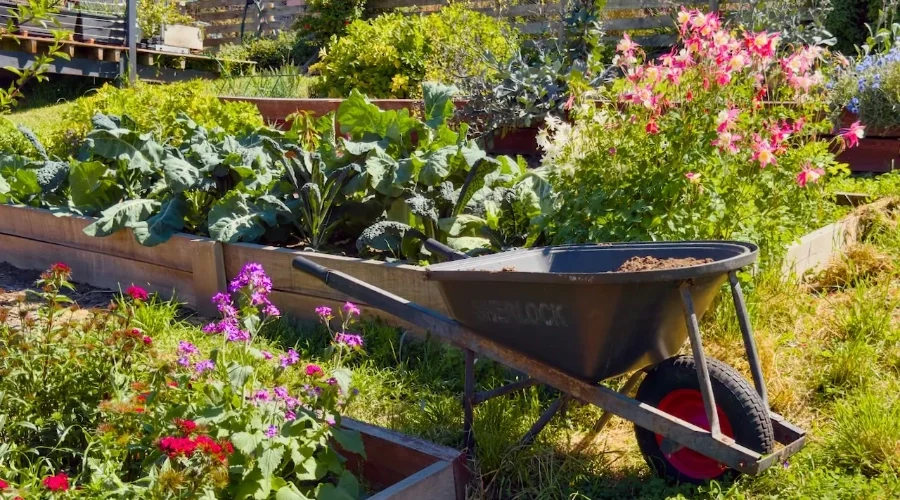
How sunlight, water, carbon dioxide and bacteria keep garden soils fertile
This is a story about how chemistry in the garden keeps our soils healthy and our plants growing.
THE PHOTON STREAM starts. It will take eight minutes and twenty seconds on its journey from the sun to the garden.
The leaves still feel the chill of the night. Glistening drops of nighttime dew still cling to their leaves.
Then the light arrives. It warms the cold leaves and triggers a phytochemical process in their deep structure. Energy flows.
It is dawn
Streaming in from the sun, the photons strike the leaf’s green pigments, its chlorophyll, that live inside chloroplasts deep in the plant’s cellular structure. Chlroplasts are thought to have evolved from an ancient photosynthetic cyanobacterium ancestor that was engulfed by an early cell.
Then something dramatic happens:
- the energy from the light splits water molecules taken up from the soil by the plant roots; it releases oxygen as a waste product that diffuses out through the leaf’s pores (water is composed of two hydrogen atoms bonded to one oxygen atom, forming the chemical formula H₂O)
- the hydrogen from the split water, plus carbon dioxide drawn in from the air, is then chemically assembled into glucose, a simple sugar that stores the sun’s energy in chemical bonds.
In plain terms: morning light triggers the chlorophyll in the leaves to produce plant food (glucose) from air and water, and oxygen that escapes into the atmosphere.
The morning passes into the midday hours
The plant doesn’t keep all that sugar in the leaves. Some of it is loaded into the phloem (the plant’s nutrient delivery system) and sent down to the roots. There, in small swollen bumps on the roots called nodules, live a bacteria known as rhizobia.
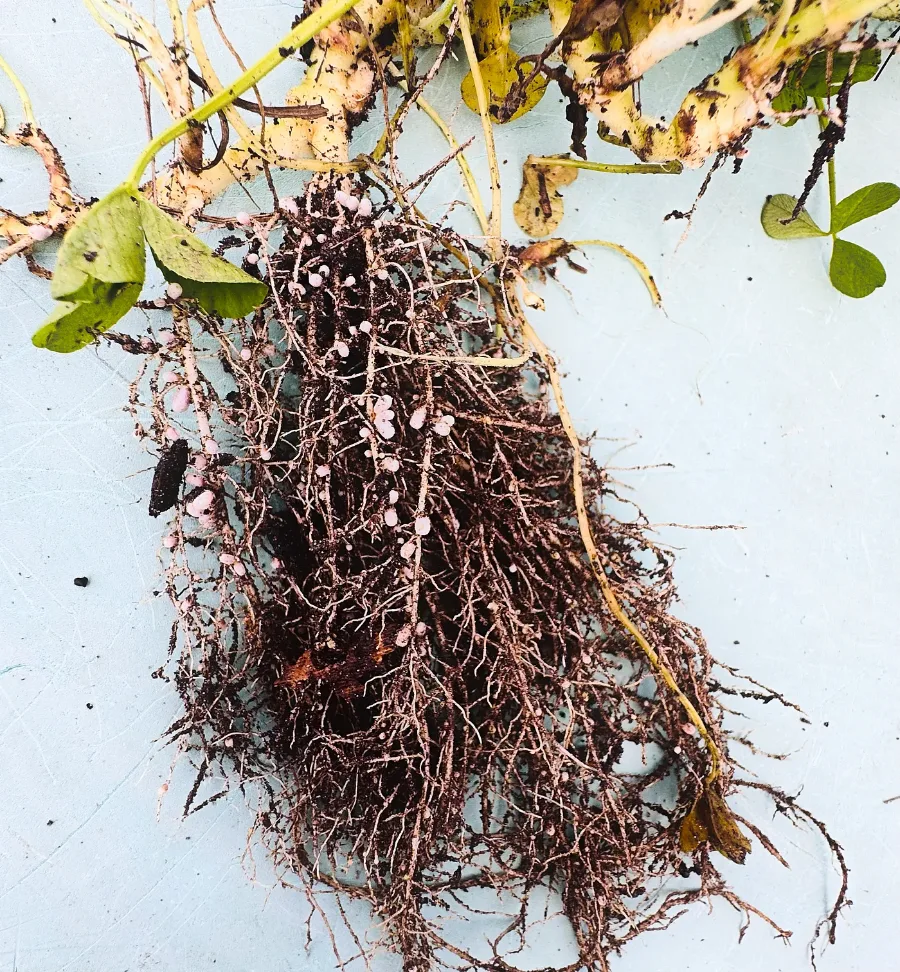
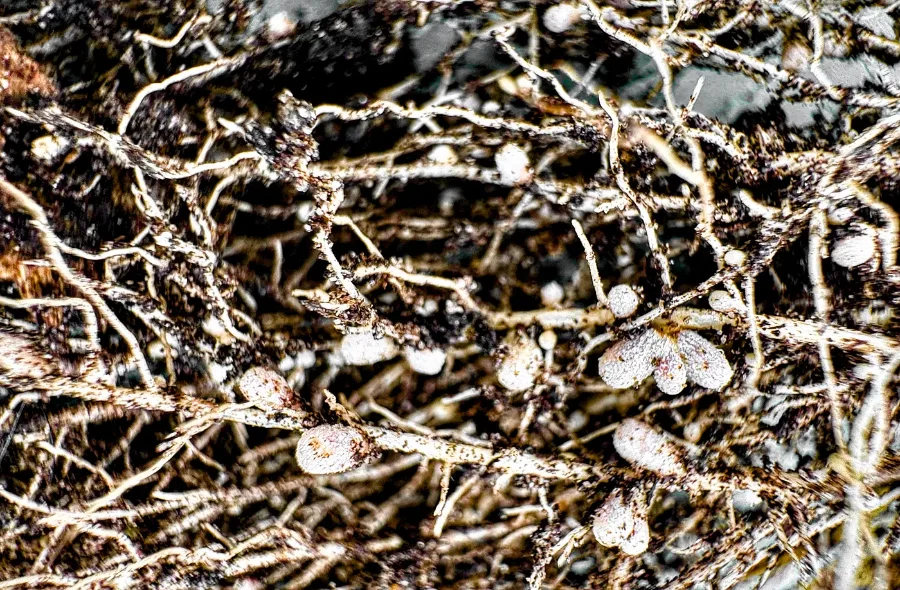
Inside these nodules the rhizobia bacteria use energy from the sugars — that were produced by the chemical process triggered by light, photosynthesis — to power an enzyme (nitrogenase). The enzyme grabs nitrogen gas from the air in the soil pores and converts it into ammonia, a form the plant can actually use.
For the technically minded, the chemical formula for converting nitrogen gas (N₂) into ammonia (NH₃) via nitrogen-fixing bacteria in soil:
N₂ + 3 H₂ → 2 NH₃. Nitrogen + hydrogen > ammonia
So the sunlight captured above ground becomes the fuel that drives nitrogen fixation below ground.
Photosynthesis, the light reactions and the sugar-making cycle, does not directly consume nitrogen gas. Yet, nitrogen is essential to photosynthesis. A large share of a leaf’s nitrogen is invested in the proteins that run the process and other proteins in the light-harvesting system. Legumes, nitrogen-fixing plants, use some of the ammonia from their bacterial rhizobium partners to make amino acids and proteins.
In other words, nitrogen doesn’t go into the photosynthetic process as an ingredient like CO₂ or water. It builds the infrastructure that makes it work.
The day moves on. It is afternoon
With a steady supply of ammonia from the rhizobium nodules the legume builds amino acids, proteins, chlorophyll and new leaves and stems. This is why legumes can grow vigorously even in low-nitrogen soils: they are effectively fertilising themselves using air and sunlight.
This is not a closed cycle. It is an open system: legumes need nitrogen-fixing bacteria, soil nutrients, water and sunlight. Energy and matter flow in and out to link them to the local environment and the sun.
Not all the fixed nitrogen stays locked inside the living plant. Some leaks from the roots into the surrounding soil. More is returned when leaves drop, roots slough off, or the whole plant dies and decomposes. Soil microbes break down this nitrogen-rich organic matter and release plant-available nitrogen that neighboring, non-leguminous plants can take up. Over time, this builds soil fertility. More organic matter, more microbial activity, better soil structure, a bigger bank of nitrogen for the next generation of plants. It is nature supplying its own needs.
This is how legumes are solar-powered nitrogen factories that build soil fertility. It is why we plant nitrogen-fixing plants, the pea and bean family, the legumes. ‘Living fertiliser’, we could call them.
Why this matters
In mixed stands or planted as a leguminous intercrop between edible species, non‑legumes can grow better next to legumes because more soil nitrogen is available.
The effect is strongest where roots intermingle, where mycorrhizal networks are active and transfer the nitrogen, and where legume residues (roots, nodules, leaves) are left in place to decompose.
Over time, repeated legume growth builds up soil organic nitrogen, improving fertility for future crops even after the legume is gone.
There are a number of main routes to nitrogen availability:
- Decomposition of legume roots and nodules
Non‑legume roots growing in the same zone as legumes take up nitrogen material, effectively using the legume as a slow‑release fertiliser. - Direct release of soluble nitrogen
Living legume roots exude small nitrogen‑containing compounds such as amino acids and passively shed cells and mucilage rich in nitrogen. Some of these compounds are directly taken up by neighbouring plants without waiting for full decomposition. - Transfer via mycorrhizal networks
Many plants, including most legumes and many non‑legumes, form partnerships with mycorrhizal fungi to set up a network of nutrient exchange in the soil. Nitrogen taken up or fixed by the legume moves through these fungal threads and is delivered to neighbouring non‑legume roots. It is like the way that a metropolitan electricity grid distributes energy to households from a power station or the way water is distributed through a network of pipes from a reservoir to home taps.
In short, non‑legume neighbours benefit because legumes turn atmospheric nitrogen into organic forms in their roots, and some of that nitrogen escapes into the shared soil space through decay, exudation and fungal networks to where other plants can use it. It’s a process of mutual benefit in nature.
Immersion in deeper systems
Some reading this will be permaculture practitioners. They will know that permaculture is based on an understanding of systems and their interactions, that Systems Theory is basic to permaculture, the integrated system of ecological and environmental design that Bill Mollison co-developed with David Holmgren. As Bill put it, it is just as much the connections between things as the things themselves that count. Those connections are vital to how systems and networks operate.
In Systems Theory, nitrogen fixation is a conversion process: sunlight powers the legume. It sends sugars to root nodules where rhizobia turn atmospheric nitrogen into usable ammonia. This resource exchange makes the root system a cooperative subsystem within the larger soil–plant–atmosphere system.
Permaculture people also know that networks are a basic structure in nature. We understand it through Network Theory: the structured analysis of complex systems represented as a set of nodes interconnected through links through which information and resources flow.
Here, the legume is a node in a network connected to several other nodes: the sun, air, rhizobia, soil microbes, neighbouring plants, decomposing organic matter. Energy moves from the sun through the plant to the bacteria, while usable nitrogen moves from the bacteria into the plant and eventually into the soil network.
Nitrogen fixation creates new links and strengthens the existing links between organisms that cannot use atmospheric nitrogen directly.
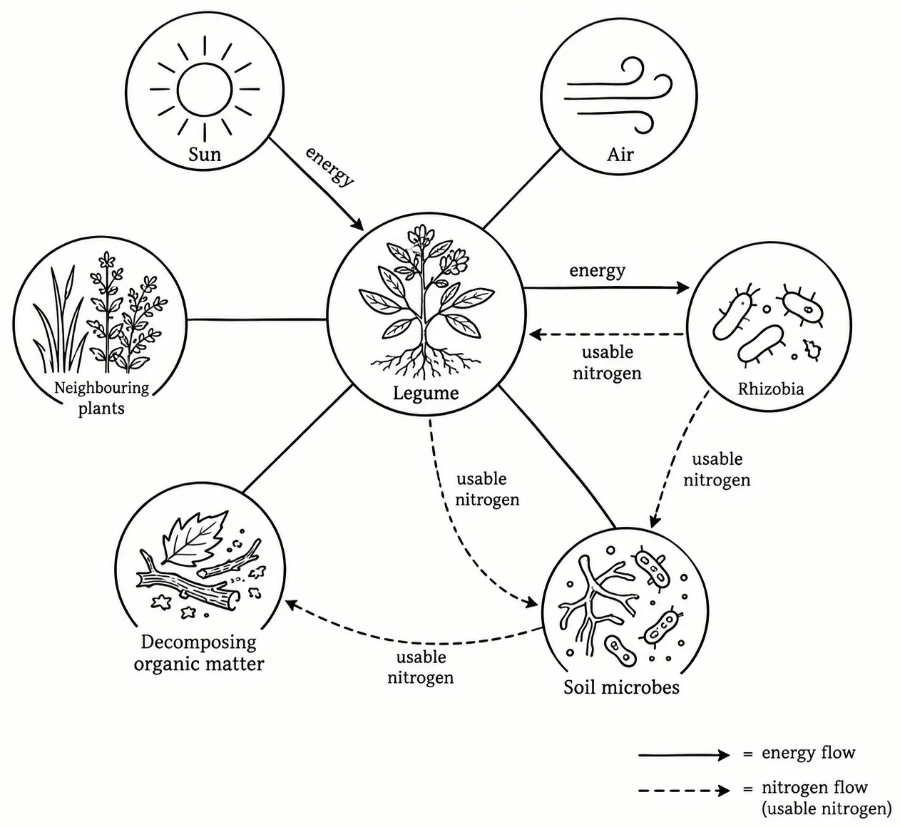
The system also has feedback, an important element in how systems work. Available nitrogen helps the legume make proteins, chlorophyll and new leaves that increase photosynthesis and provide more sugar to the bacteria. Later, root exudates, dying nodules, roots and leaves release some nitrogen into the soil. There, microbes transform it into forms that other plants can absorb. In this way, nitrogen captured from the atmosphere enters the shared soil nutrient cycle.
Let’s apply this in our veggie garden
We can boost nitrogen fixation through proximate planting that encourages root contact, through crop rotation and the placement of legumes in guilds.
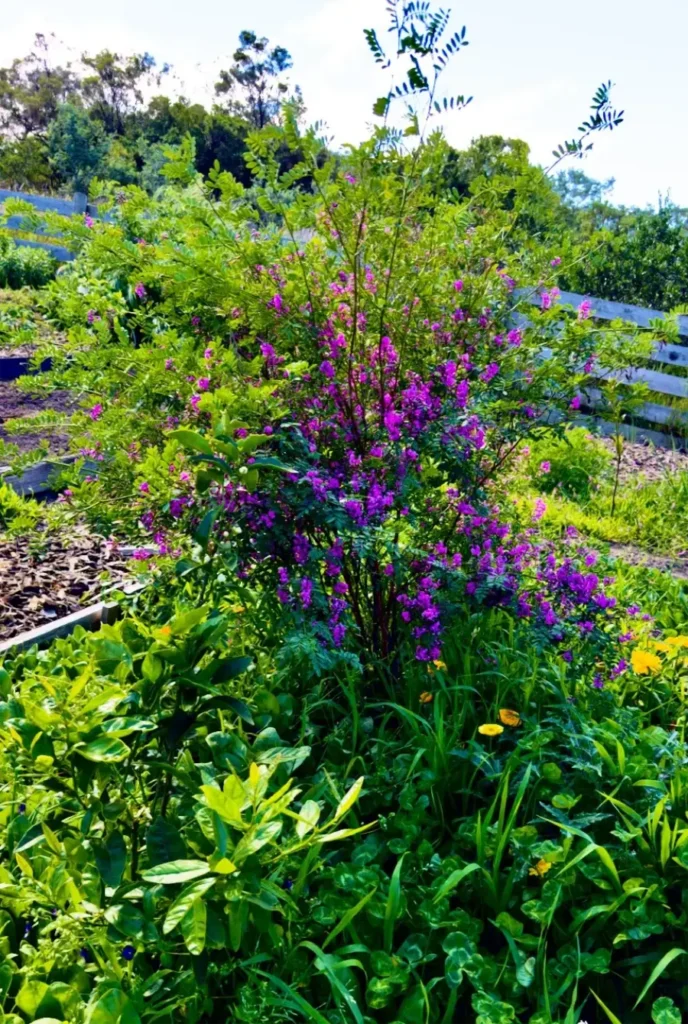
Guilds are composed of a main crop, such as a fruit tree, closely planted with a legume to increase nitrogen fixation, and flowering plants to attract pollinators such as bees.
For vegetable cultivation, flowering species can be planted at both ends of a garden bed with legumes interplanted as strips between vegetable types.
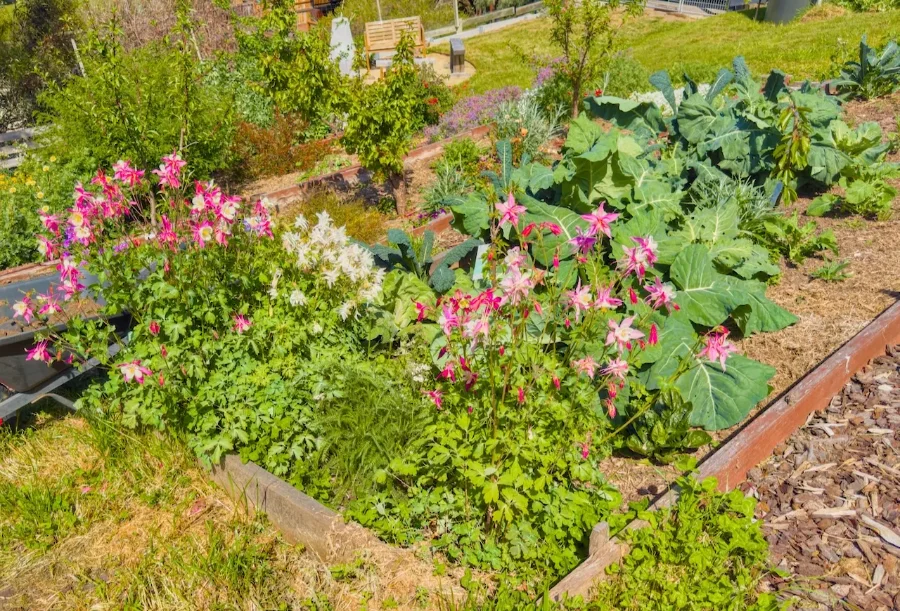
Legume intercropping involves alternating rows of vegetables with peas or beans or other edible leguminous crop.
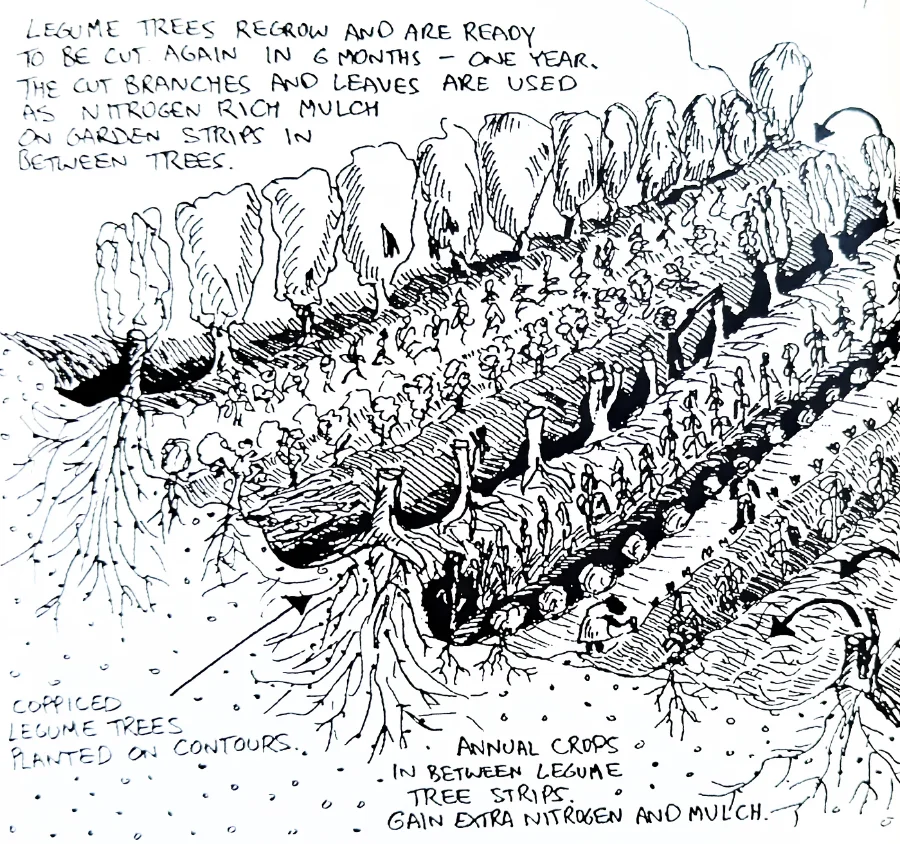
I know this method at larger scale from work in the Solomon Islands. There it is known as ‘alley cropping’. Leguminous trees such as Gliricidia are planted in rows with edible crops such as sweet potato cultivated in the intervening spaces. The softer branches of the trees are periodically pruned and left in the crop alleys to decompose and release nitrogen into the soil. The trees also serve as a windbreak to protect the crops, while regular pruning prevents them from reaching their maximum height.
Another approach is to plant corn followed by climbing beans once the corn is around 10cm high, then followed later by squash. This method was developed by traditional South American farmers and is known as the ‘three sisters’ planting system.
Successional planting in crop rotation uses annuals (seed to seed in a year), with nitrogen fixers as a green manure in the sequence. A garden bed follows a simple sequence:
legumes > leaf crop (eg. silverbeet, spinach, bok choi) or fruiting vegetables (eg. tomato, capsicum, eggplant) > root crops > legumes > repeat cycle through the seasons.
A most-important plant
Legumes are among the most important plants for home gardens.
They are easy to grow and suitable for succession planting. With the rhizobia bacteria in their root nodules they fix atmospheric nitrogen into plant-useable form and boost soil fertility. Some of their nitrogen feeds nearby plants as residues leach out and plants break down. Beans and peas provide nutritious food while supporting the soil community: flowers attract pollinators, foliage provides ground cover and roots improve soil structure.
In doing this they fulfil two principles of permaculture design:
- Each element performs many functions. Each element performs several useful functions. In a home food garden legumes provide food, fix atmospheric nitrogen through their partnership with rhizobia, contribute organic matter, protect the soil and provide habitat for beneficial insects
- Each important function is supported by many elements. With the use of compost, mulch and other methods legumes form one component of our soil improvement strategy. They contribute to resilience by ensuring that essential garden needs do not depend on a single component.
Together, the two principles encourage us to design gardens in which the elements work together, resources are used efficiently, and the failure of one element does not compromise the whole system.
