Sign In
  • Log In
  • Register

Lost Your Password?

Registration is disabled

Permaculture Tasmania
  • Home
  • About us
    • About us
    • Get in touch
    • AGM 2026
    • AGM
    • Meet the team
    • Member discounts
    • Newsletters
    • Life members
      • Our Lifetime Members
      • Life member profiles
      • Lifetime Membership Nomination
  • Find an event
    • Book club
    • Course
    • Festival
    • Get togethers
    • Market
    • Online event
    • Repair cafe
    • Seed / food swap
    • Workshop
  • Find connections
    • Permaculture groups
    • Organisations / businesses
      • Community garden
      • Community organisation
      • Crop / seed swap
      • Design service
      • Ecovillage
      • Food delivery
      • Free / trading
      • Markets
      • Repair cafe
      • Retailer
      • Seed suppliers
      • Social enterprise
      • Training
  • Blog
    • View all Blog posts
    • Bush foods
    • Book review
    • Design
    • Permablitz
    • Permaculture
    • Permie profile
    • Plants and gardens
    • Resources
    • Stories
    • Water
  • Join us
    • Join us
    • Member discounts
    • Join a local Facebook group
Permaculture Tasmania
  • Home
  • About us
    • About us
    • Get in touch
    • AGM 2026
    • AGM
    • Meet the team
    • Member discounts
    • Newsletters
    • Life members
      • Our Lifetime Members
      • Life member profiles
      • Lifetime Membership Nomination
  • Find an event
    • Book club
    • Course
    • Festival
    • Get togethers
    • Market
    • Online event
    • Repair cafe
    • Seed / food swap
    • Workshop
  • Find connections
    • Permaculture groups
    • Organisations / businesses
      • Community garden
      • Community organisation
      • Crop / seed swap
      • Design service
      • Ecovillage
      • Food delivery
      • Free / trading
      • Markets
      • Repair cafe
      • Retailer
      • Seed suppliers
      • Social enterprise
      • Training
  • Blog
    • View all Blog posts
    • Bush foods
    • Book review
    • Design
    • Permablitz
    • Permaculture
    • Permie profile
    • Plants and gardens
    • Resources
    • Stories
    • Water
  • Join us
    • Join us
    • Member discounts
    • Join a local Facebook group
Sign In Add Listing
What is Permaculture

What is Permaculture

  • By Russ Grayson
  • 19/09/202427/09/2025
  • Permaculture

Permaculture is

Permaculture is a system of design for sustainable human habitat — an approach to ecologically sustainable development which can be used by individuals, communities, business and government. It seeks to improve our quality of life while improving the social, urban and natural environments.

Wherever we live, we can start to make changes to reduce the environmental and social impacts of our lifestyles. At the same time, we can value quality of life over the ownership of more and more possessions and the waste and personal debt that brings. We aim for sufficiency, not the extreme of excess.

Permaculture design is a process of combining techniques from a wide range of activities such as organic gardening and farming, energy efficient building design, community economics, landscape design, environmental restoration, town planning and community development. It brings these together so they interact in ways that benefit people, conserve resources, make use of renewable energies and restore degraded landscapes.

A practice based on ethics

Permaculture is guided by three ethics:

  • care of the Earth
  • care of people
  • sharing what’s spare

Care of the Earth and care of people go together — one cannot be achieved without the other. Making a contribution means distributing our surplus resources such as knowledge, skills, funds and materials to assist others provide their own life needs.

Practicing Permaculture is about innovative thinking…

  • see solutions, not problems
  • think about the long term consequences of your actions assist people to become self-reliant
  • rebuild communities and promote community development use everything fully; recycle all wastes
  • bring food production back into the cities
  • restore degraded landscapes and soil fertility
  • use diversity to encourage stability and readiness for social and ecological change
  • cultivate the smallest possible area of land; design small- scale, energy-efficient intensive systems rather than large- scale, energy-consuming extensive systems
  • use species native to the area where possible or naturalised species known to be beneficial
  • reafforest the land.

Permaculture… it’s about modern living based on co-operation… about improving the places in which we live… it’s about being engaged citizens rather than passive consumers

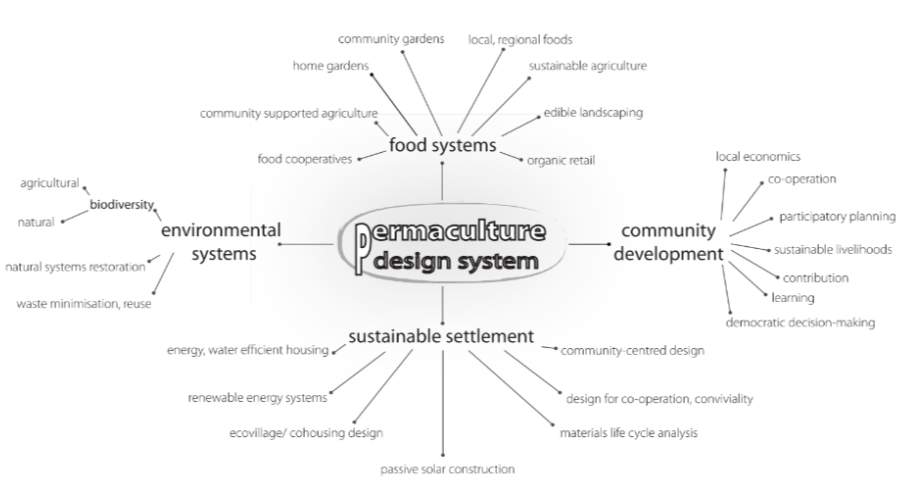
Permaculture supports community development and social enterprise, local economies, the design of the places we live for social and environmental amenity and the development of local food systems.

Food systems

You can grow some of your own food needs in your home or local community garden. If you are not interested in gardening, buy your food from a food co-operative, community supported agriculture scheme, farmers’ market or organic retailer.

Sustainable settlement

Permaculture designers have been involved in the development of ecovillages in Australia. Ecovillages are designed to high standards of environmental amenity and encourage co-operation among residents.

In designing ecovillage and private housing,

Permaculture makes use of solar design and renewable energy technologies.

The places where we live should be people-centred, not designed solely for vehicles, and include plenty of open space for recreation and community food gardens.

Social meeting places are important components of urban design.

Environmental systems

Within the settlements in which we live we can include space for natural systems, whether existing or planted, that provide environmental services such as windbreaks, wildlife habitat, environmental restoration, food and timber.

In Permaculture design, we design systems that reuse reprocessed wastewater and we make use of other wastes through re-use and recycling. The aim, in Permaculture design, is minimal waste.

Community development

Individuals accomplish more when they voluntarily co- operate with others. Participatory planning and decision making are part of the Permaculture design system.

By buying local foods, services and products, we keep money circulating in the region before it is spent outside, assisting in the development of local economies which help to cushion communities from the negative impacts of the global economy. Excess personal and organisational funds can be placed with an ethical investment company or with a local, independent bank.

LETS (Local Energy Transfer System — a form of cashless or part-cash trading) encourages community- based trading, the maintenance of livelihood skills and the development of community linkages.
Post navigation

Previous Post A short and incomplete history of permaculture
Next Post Tasty saltbush

Leave a Reply Cancel reply

Your email address will not be published. Required fields are marked *

Got Any Question?

If you are having any questions, please feel free to ask.

Send us an email

Share our blog post…

  • Share
  • Share
  • Pin It

Latest blog posts

  • team-2026-27
    Meet the Team — 2026-2027
    29/09/2026
  • Newsletter Spring 2026
    Member Newsletter — Spring 2026
    31/08/2026
  • Golden Scallopini
    Golden scallopini: a small, bright summer squash
    31/08/2026
  • Bird flu response
    Tasmanian Bird Flu Response
    31/08/2026
  • food regulations image
    When the community food movement meets the regulators
    31/08/2026
  • Favourite things Patrick
    My Favourite Things — Patrick Casey
    31/08/2026
  • Women Farmer Sri Lanka event
    Organic Women Farmers in Sri Lanka
    31/08/2026
  • Principe one with Loretta
    Permaculture principles for beginners — No. 5
    31/08/2026

Permaculture Tasmania logo

Permaculture Tasmania Inc acknowledges with deep respect and gives gratitude to the traditional inhabitants of this land — for whom the waters of, and land around lutruwita offered sanctuary and great abundance.

We honour their continuing custodianship and extend deep respect to all Aboriginal Communities — who are living examples of resilience — having survived invasion, dispossession and now climate change.

As we move towards reconciliation, we will not forget their connection and their unbroken custodianship; and we pay respect to those elders who have passed, and those who today continue to care for Country.

Search our Blog

Helpful Links

  • Home
  • About us
  • Find an event
  • Permaculture groups
  • Member Login
  • Get in touch
  • Privacy Policy
  • Terms and conditions

Except where otherwise noted, content on this site is licensed under a Creative Commons Attribution-NonCommercial-ShareAlike 4.0 International License.

© 2026 Permaculture Tasmania Inc. — ABN: 48 146 919 973
Hi! Can I help you find an event?
AI Assistant
Expand chat Collapse chat
Start a new chat
Powered by PurioChat