Searching for resilience
Story by Russ Grayson, member of Permaculture Tasmania
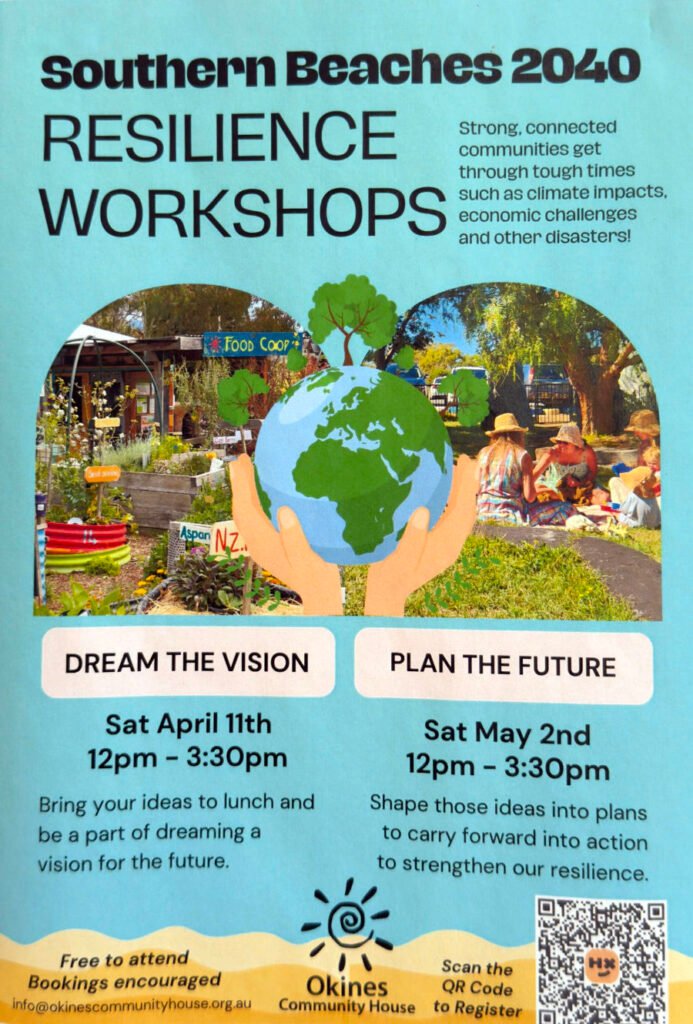
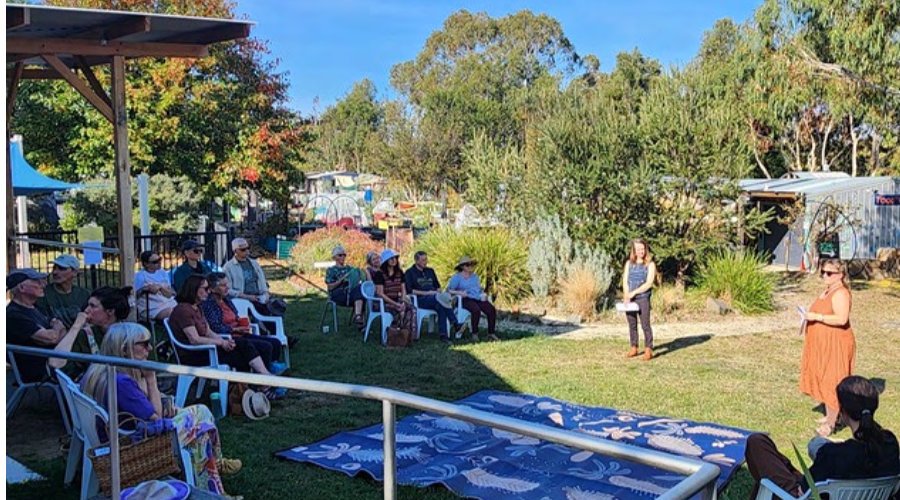
The room hummed with voices. It was the second session of the Resilient Southern Beaches 2040 program at Okines Community House — our community hub by the bay. The first session, months ago, told stories of our place. This one asked questions. The next one turns the answers to those questions into a plan.
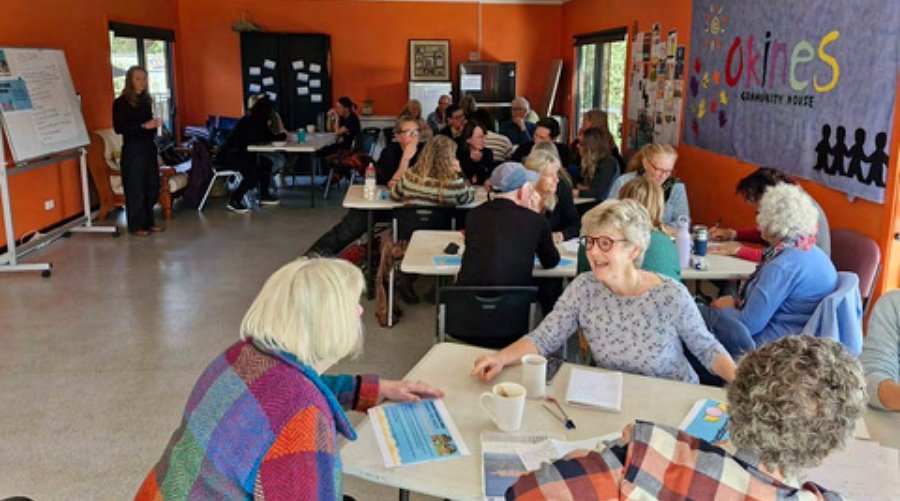
Around thirty, maybe forty people filled the room. The facilitator had come from Hobart. She led a process that kept on time. We used the World Cafe model to explore what local resilience would look like — let’s think of resilience as the capacity to withstand and recover from external pressures. Eight tables. Eight themes. We rotated, shared, wrote and moved again. At each stop, a concept map of a resilient town started to take shape in words.
What do we like about living here?
What do we want to protect?
We start. The facilitator asks these two questions, one at a time. They are scene setting questions designed to bring focus. The answers come fast. We speak of what gives this place its attraction as somewhere to live. Clean air. The town’s walkability. No highrise. The bay and the marine environment. The wildlife. A town still human in scale.
And what do we want to protect?
- our town’s history
- clean water
- clean air
- the beaches
- the marine environment.
Then comes the harder question: what worries us most?
In the practice of Stoicism, ‘negative visualisation’, identifying what could go wrong, is the start of working out what can be done about it. It is also done in risk management. And the risks, the challenges identified? The climate. The sea eroding the foreshore of the bay. Drought. Bushfire. Sea level rise. Impenetrable bureaucracy. Tasmania’s controversial fish farms, though there are none in the bay. Food security, perhaps a response to the current fuel crisis and its potential to disrupt food supply chains. The rise of the far right. The impact of disinformation. Unexpected worries, those last two.
All are islands of anxiety in the rough water of a chaotic world.
Looking beyond
“What do you want the town to be by 2040?” the facilitator asks.
Ideas spill like the scurrying soldier crabs out on the tidal sand flats. Community-driven governance. Caring for an ageing population. A town solar farm to produced local energy. Electrified transport. Safety. Shade. Enabling tiny houses as an alternative type of accommodation. Skill sharing. Local ownership. Planting fruit trees in public places for foraging. A secure food supply. The protection and enhancement of our existing values.
Other ideas emerged over the course of the session. Understanding how political systems work and how they can be changed was one. Somebody suggested knowledge hubs and a register of community skills. Community mapping, too. Engaging younger people was mentioned a couple times so they have a sense of belonging and connection, and places to connect. Encourage them to be engaged in the life of the town.
“And the bridge?” the facilitator asks. “How do we get from now to then?”
The answers have a social focus. Well-being. Connection. Access to knowledge. A noticeboard at the centre. A hall for larger meetings. Youth engagement. Peer networks. Shared skills.
American author, social activist and philosopher, Grace Lee Boggs summed up the vibe of the session:
“We can begin by doing small things at the local level, like planting community gardens or looking out for our neighbours. That is how change takes place in living systems, not from above but from within, from many local actions occurring simultaneously.”
A rhyme in time
I sit there. Something about the afternoon feels familiar. Then it strikes me. Transition Towns. Years ago, I became trainer in that movement following a course run by two people from the UK town of Totnes, the movement’s birthplace. Sitting here today the realisation sweeps over me again, the realisation that what Mark Twain said is all-too-true:
“History does not repeat itself. But it does rhyme.”
This was like the Transition Towns visioning meetings we used to have when Transition Towns (and here) were a thing more than a decade ago. The Transition Town idea still exists but it has faded since it first caught the attention of people who were ready for its message. Now, here is the same energy, the same hope. A different demographic. A different place. Those things might change, but the spirit doesn’t.
I think that one reason behind why Transition Towns as a social movement went into decline, was there was too much overlap with ideas coming out of the permaculture design system. Some permaculture practitioners adopted the Transition Town model. I welcomed that because it brought in people unconnected to permaculture and in doing so broadened the ambit of the permaculture movement. For a moment I envisioned it as a new iteration of permaculture… Permaculture v2.0. But it was not to be. In a situation where there are too few points of difference, it is likely that that with first starter advantage prevails. Transition Towns was mentioned by one of the participants at the resilience planning event, a different person to the one who said he used permaculture ideas in his life.
Why here? Why now?
Where did all these ideas come from? These are people living mainstream lives. Twenty years ago, you wouldn’t have heard those comments about food security, edible landscaping in public places, active transport, a solar farm, community involvement in governance and the potential impacts of climate change. They were still very much the property of the permaculture and Transition Towns movements. Nor would you have encountered the challenges of the rise of the far right and of the impact of disinformation from people in small towns like this one.
So what does their presence here on the southeast coast of Tasmania say about what has happened over the intervening years?
How is it that these and other ideas have permeated the consciousness of people living in a coastal town where fishing, boating, kayaking on the stillwater, and catching the swells coming into the bay at the local surfing beach are among the main preoccupations?
I think it’s indicative of how ideas once within the permaculture design system have passed through its leaky margin and into the social mainstream. I don’t think it’s permaculture alone that is responsible for this. After all, there was only one mention of it at the resilience workshop. It’s more about the spirit of the time, the zeitgeist, and people grasping at potential solutions to the accumulating challenges facing us today. It is as if it is the times themselves surfacing ideas that have been around for years and are now more timely.
I have seen elsewhere how our current fuel supply/cost crisis is stimulating ideas that previously lay below the social surface. Crises do that. They force things to the top where they become visible.
Could permaculture offer a strategy?
But, a question: if ideas once heard mainly in permaculture circles are now circulating in the social mainstream, where does that leave permaculture? Has it lost the edge? Lost it’s content? It’s point of difference? Let me put it bluntly: has permaculture become stale? Is it trying to build its presence on ideas that are now circulating in society? If so, how does it build new ideas that are attractive? Is it too backward-looking in its ideas? I would like to hear your response to that provocation (in the comments).
If that is true, then we can adopt Marcus Aurelius’ proposal: “That which is an impediment to action is turned to advance action. The obstacle becomes the way.” Or, as Bill Mollison would rephrase it two thousand years later: “The problem is the solution”.
The impediment, the problem, is lack of a cohesive framework in mainstream society through which to view our challenges and propose our solutions. The ideas are there but they are scattered, disconnected. The way… the solution… and the challenge for permaculture people engaged in community resilience programs like that here on the Southern Beaches is this: how do we introduce permaculture as a design system for community resilience? And here I mean permaculture that is far more than backyard gardening and that includes a strong social content such that would bring these disparate ideas together? Could permaculture be the conceptual box into which the mix or ideas is tossed and where they mingle and interact to become a cohesive, forward-looking strategy that addresses the questions of our time?
That has always been a thing in permaculture. It has a good analysis of what is wrong and good ideas to make them right, but it has lacked a strategy to make those ideas real. Permaculture’s focus has been mainly at the tactical level… home food production, community gardens, energy efficient building design, ecovillages and the rest of its good and viable ideas. But where is the strategy that empowers and directs those tactics to take us somewhere? Bill talked about building “sustainable settlements”. That is the end goal, but how do we get there? That’s where we as a social movement need strategy, a process of moving forward.
We need a frame to hold the scattered ideas coming from the community resilience workshop together. The planning stage should produce that. Next month, the final workshop. Planning. And maybe even small seed funding. Could permaculture formulate such a framework? Permaculture is not limited to backyard food production, yet that is still what a great many people see it as. It focused on that for decades, a worthy focus for sure, but at the same time it built a cage for itself. That cage was reinforced by the popular portrayal of permaculture in the print and online media and through TV gardening programs. Backyard food production is an individual asset but it needs to be linked to the big picture issues such as food security so it becomes a social asset. That is, a conceptually-bigger permaculture with a focus on society, not just the individual, not just the household. A permaculture for all citizens. A design system for resilience.
A small step forward
Transition Towns… pemaculture and its future… I’m wandering off course for a story about a community resilience-building program. In returning to it, let me say that the event carried a positive vibe in that those participating have a proactive view of community initiative and the sort of attitude about place that would have been at home in the idea of bioregionalism in the days when it, too, figured prominently in permaculture.
I’m left wondering whether we need to dust off those old books on Transition Towns and mine them for ideas. I’m also left wondering whether community resilience programs are something that the permaculture movement could do as a new approach to scaling-up the design system. What do you think?
Helen Keller: “Alone we can do so little; together we can do so much.”
The quote clarifies that building resilience will not come from the doomed, go-it-alone approach of survivalists in bunkers, but from hands joined across the table, minds co-operating and not competing to build communities strong enough to weather the storm.