This article may prove to be very controversial and it may not?
I have been sitting on it for a while now, wondering whether the secretary of the organisation should have these feelings, and moreover whether she should voice them? After talking to my good friend over a grazing platter, I decided to put my big girl pants on and publish this article. Please remember, this is how I perceive things. Others may not see it this way. But I believe that there is a place for permaculture in whatever form it comes, whether you call it that or call it something else….so here goes nothing, or everything.
The weather is finally changing from warm days and chilly nights to cool days and frosty nights. Our fire has a steady flicker of flame and a constant warmth that hugs you as you enter the home. Tomatoes are still being preserved slowly on the wood stove and the quinces are hogging up valuable bench space waiting for the right moment to be made into gloriously coloured jam. This bounty of food came from a local crop swap that was started by me, my husband and our good friend Pat. What started as a group of 6 friends and strangers, sharing some extra garlic, seed and a few vegetables whilst chatting about our commonalities over a cup of tea and a slice of cake, has grown into a small community of around 60 members, eager to share their food, their knowledge and their friendship.
The Permaculture Tasmania: Meander Valley Group is alive!
But my ‘permaculture’ journey didn’t start there. I use quotation marks as both a sign of my confusion and a nod to its inherent elitism as a group of people who are bonded by the sacred PDC; permaculture design course. And I don’t say this to offend. I just mean to express my consternation at a label that can make something so wholly encompassing yet totally exclusive at the same time.
I come from an Italian, Egyptian, British background. My grandparents grew and made their own food, my parents did the same and so do all of us kids. Even the grand and great grandchildren are growing their own veg at home. This is what we did. When the migrants of the 50s came, there wasn’t their traditional ingredients and foods but there was their traditions, buried deep within them. They brought the seeds of their favourite fruit and veg and the recipes passed down from Nonna to Nonna and Beba to Bebo. We farmed our backyards, and even our fronts, we made our salamis and olives and shared the company and wisdom of family and friends. This was our version of ‘permaculture’; working with nature and not against it. Designing systems to make our gardens, kitchens and communities flourish. Using every small space, every spare scrap of bread and getting together as a community to share the abundance and the labour.
When I was teaching, I wanted kids to know what food was and where it came from. The principal asked for an idea for a staff bonding day that would also benefit the school. I suggested making a veggie patch. Of course I also had to fit in into the curriculum so I started doing some research to make it fit. I happened upon a book about companion planting and decided that I could squeeze that into the social skills aspect of the curriculum through the lens of developing relationships and the science of how living things adapt to their environments. In that book was a description of permaculture: a way of gardening that works with nature, not against, using natural techniques to grow good old fashioned healthy food. I explained these concepts as merely what people did before industrialisation of foods and got the staff to build a substantial raised vegetable bed garden, and companion planted some vegetable seedlings. We had a bbq and some beers and everyone went home feeling like they had gotten out of doing any boring curriculum planning and tedious group discussions. I called it the Permaculture Garden and so it remained for the next 20 plus years.
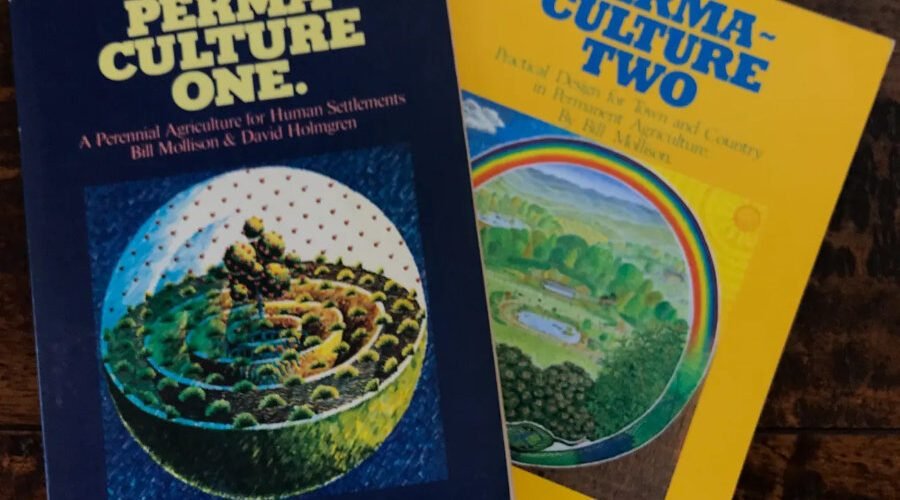
Little did I know then that two men, called Bill Mollison and David Holmgren had coined a phrase describing exactly what people had been doing for centuries and that I had been using it in its simplest sense. Many years later, after having added a bush tucker garden, a national park (proclaimed by me) raised beds in every spare part of the school grounds and added chickens to the mix (I had wanted a miniature cow and some sheep but inner city council rules forbade me), I met my partner and he raved about this man David and that he had a farm we could go and visit. I bought him and I tickets to a day course and his and Su’s house. Here is where I put two and two together and got a proper understanding of what the word ‘permaculture’ was really about.
I loved every minute of that day, but I didn’t learn much. My mum used to make her own flour and bake bread when I was a kid, my dad would put the chook poo on the fruit trees and make things from nothing like vases from glass bottles and toys from wood scraps. All of us kids had grown up making gnocchi from scratch, canning fruits and veg, chopping wood and rescuing stray animals including a cockatoo called Mr Magoo who could swear a blue streak. So, this was it; only it had a fancy name. I was perfectly fine with that name until only recently. I revelled in the fact that I had met the man that had coined the phrase that would make people understand my life with the minimum number of words…permaculture.
Fast forward a few years, one pandemic, a new husband and a property in Tasmania, and one night changed my world. John had come home and said that he had an online meeting with some people about something or other (no I wasn’t really listening) and I said, “sure” thinking that I would just have to sit there and listen. A Permaculture enthusiast, somehow, he had heard or been asked by one of the many people he meets on the daily, to attend the Permaculture Tasmania Annual General Meeting. The meeting started and the mood was sombre. Somewhere between “welcome” and “congratulations”, Permaculture Tasmania had been saved form closing, John the new president and I was an ordinary committee member.
Oh, how excited I was to be part of something so huge, so prestigious and so totally aligned with my way of life. The committee would meet. Life members working with new members, all striving towards a common goal; the resurrection of Permaculture Tasmania. The first year was slow going. Re-establishing membership databases, finding the right password or contact for that website, app or service. Trying to fulfil the wants and needs of the membership in their local areas and attending events to let the people know that PT was back. We held our first AGM, which we muddled through somehow, as by now I had become the secretary and had no idea what I was doing. Consensus was reached that we were doing quite a good job of reinvigorating the association and that we were ready for more. Another eight months has passed since then and we have made great strides. We have had a strategic planning day, worked on our governance, attending events almost every weekend in some way, shape or form and started the establishment and re-establishment of local groups. What I wasn’t planning on was a constantly nagging feeling that either I was a fraud in this permaculture world or that this world was being held hostage by the very course that it designed; the much-ordained PDC.
I am torn, I don’t feel like a fraud. Permaculture is a way that I have always lived my life but, and here is the kicker, I am secretary of the association that is in the birthplace of permaculture, and I do not have a PDC. This course is worn by permies as a badge of honour, and I admire anyone that has completed it. Yet those that don’t have it are looked at with a raised eyebrow and an air of unwelcomeness. I have never myself have been the recipient of this look, because I have never said that I don’t have my PDC certification; no one has ever asked. But I have witnessed it. The very principles within which permaculture is framed, fair share, people care and earth care, are what is not practised by the very nature of having a course only accessible to those with the financial means of gaining it and are then deemed not a real permie. How is that fair? How are we sharing the knowledge? Do we really care about those outside of our permaculture world? I know the answer is that we all do really care. That we are willing to share the knowledge. That we have a vested interest in the earth but does the giving of this way of living a title make it elitist and a barrier to some. Yes, it does.
Of course, this is not applicable to all permies that I have met. In fact, it doesn’t pertain to the majority. But as the saying goes, a few bad permies spoil the whole damn lot. Through a recent member survey, a comment was made that if PT wants to go forward, it needs to get rid of “the prats and wankers that think they are better than everyone else and get some decent people in.” I believe that the “prats and wankers” are few and far between, but I also think that the opinion is out there and valid. I have enrolled in an online PDC, I did so when the journey of PT began. Have I completed it? No, in fact I haven’t even started it. Why? Because after being a teacher for nigh on 25 years, I promised myself that I would no longer sit through courses that teach a granny how to suck eggs. I also have a severe aversion to being forced to conform when I feel that the purpose is redundant and the knowledge is not secret. I do not portend to know everything about permaculture, organic farming, biodynamics, agriculture or why my coriander bolts every time, but I do know enough to feel like I am a permie and that I can make a valuable contribution to my and other people’s food security, I can help to grow and nurture thriving communities and I can be instrumental in protecting the natural world. All of this I can feel without having a PDC. And I want others to feel that way too, without the stigma of having to have a PDC and be perfect at systems farming.
I just want everyone to grow a carrot, watch a chook run around the yard, find satisfaction in making a pot of jam and just be kinder, to others, to every living thing and to themselves. You don’t have to have a certificate to be a permie, you don’t have to know everything, and you are allowed to make mistakes. In fact, it is mandatory. So, get out there and plant a seed; a seed of hope, a seed of community, a seed for the future, because deep down inside, and whatever or however you want to label it, there is a little permie wanting to thrive and Permaculture Tasmania can help bring that little permie out into the big wide world.